topics and methods in global environmental policy I + II
GEP 268-269 is a two-course sequence co-taught by Marshall burke and Solomon hsiang designed to bring students up to the frontier on both topics and skills. The topics in the sequence relate to determinants of human well-being over the short and long-run, with a focus on the role of environmental factors in shaping development outcomes. The skills relate to gaining facility with main types of data and methods that underlie quantitative research in the environmental social sciences, including spatial data analysis, econometric concepts related to causal inference, machine learning concepts relevant to modern social science research, how physical science models are integrated to social science research, data wrangling skills, data visualization, and the design and assembly of a research paper. Each of the two courses in the sequence is divided into two modules of five classes focusing on specific topics (see diagram).
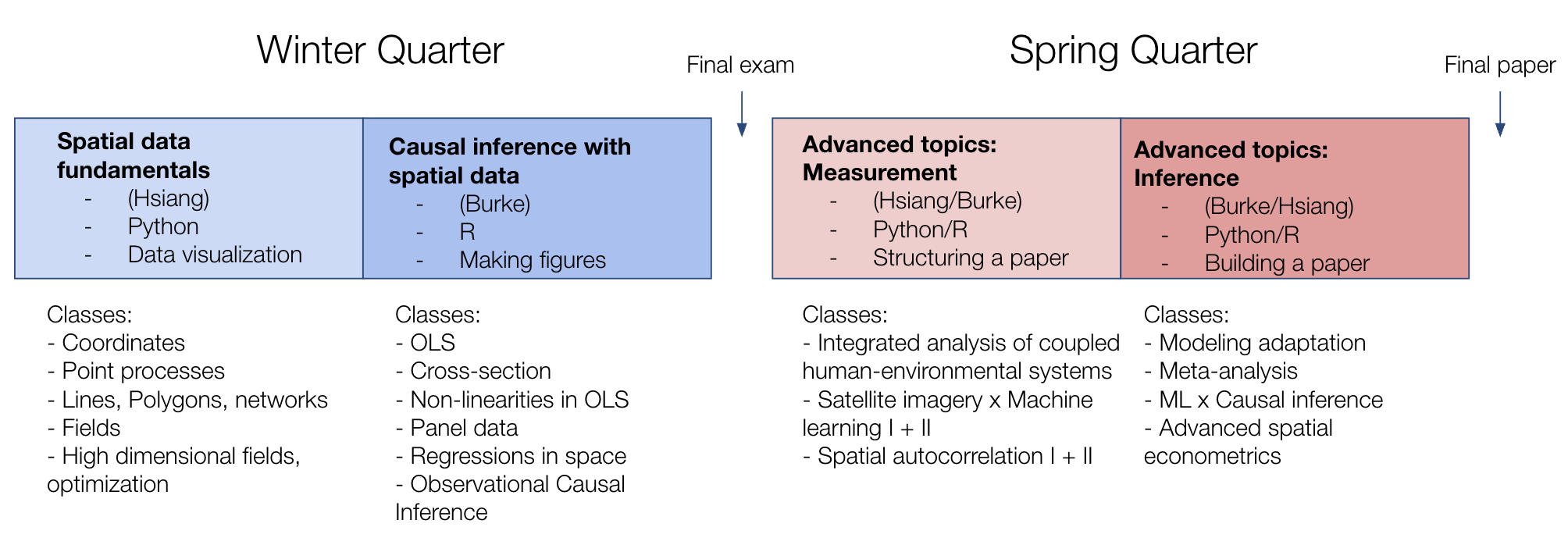
In the winter quarter (GEP 268), the first module focuses on the fundamental elements of spatial data and how they are analysed – the goal of this module is to learn how to “think spatially” about a variety of analytical problems. The second module focuses on causal inference in a variety of policy and environmental contexts, usually where spatial relationships play a central role – the goal of this module is to learn to think scientifically about naturally occurring variation in data. Because these modules focus on core fundamentals, there is a final exam at the end of the quarter to help students review and solidify their mastery of the material.
The spring quarter (GEP 269) focuses on advanced topics that build directly on tools and concepts developed in the winter quarter. The third module in the sequence (the first five weeks of the spring quarter) focuses on a variety of measurement challenges and tools used in frontier research, ranging from the use of physical models and remote sensing tools to build data sets to understanding the challenges of existing data collection systems. The fourth module focuses on a variety of advanced topics in inference, ranging from integrated assessment models and meta-analysis to the use of machine learning for causal inference.
Overlaid on this topical agenda are assignments and material that will develop two other skill sets within students across the two-course sequence. First, students will learn to code in two widely-used modern languages used in research: R and Python. Second, students will learn to develop the components and structure of a research paper. We will not have the space to focus in depth on writing the text of a research paper, but students will learn how to develop data visualizations, effective presentations of analysis, and the design of a paper’s architecture. Assignments and class time will also be aimed at practicing critical components of the research pipeline that are often not taught, including how to come up with a good research question, how to effectively frame your research findings, and how to make more compelling presentations of your results. Students will get the most out of the course if they arrive with a working programming knowledge (preferably either R or Python, or a comparable programming environment) and some previous exposure to econometric methods or upper-level statistics related to causal inference. This sequence is designed to complement and build on core classes on statistics and causal inference, it is not a substitute for these courses.
Course pages
Topics and Methods in Global Environmental Policy 1 (GEP 268 . stanford login required)
Topics and Methods in Global Environmental Policy 2 (GEP 269 . stanford login required)